-
Fine Music Research Mission Outline October 2
Two Interviews
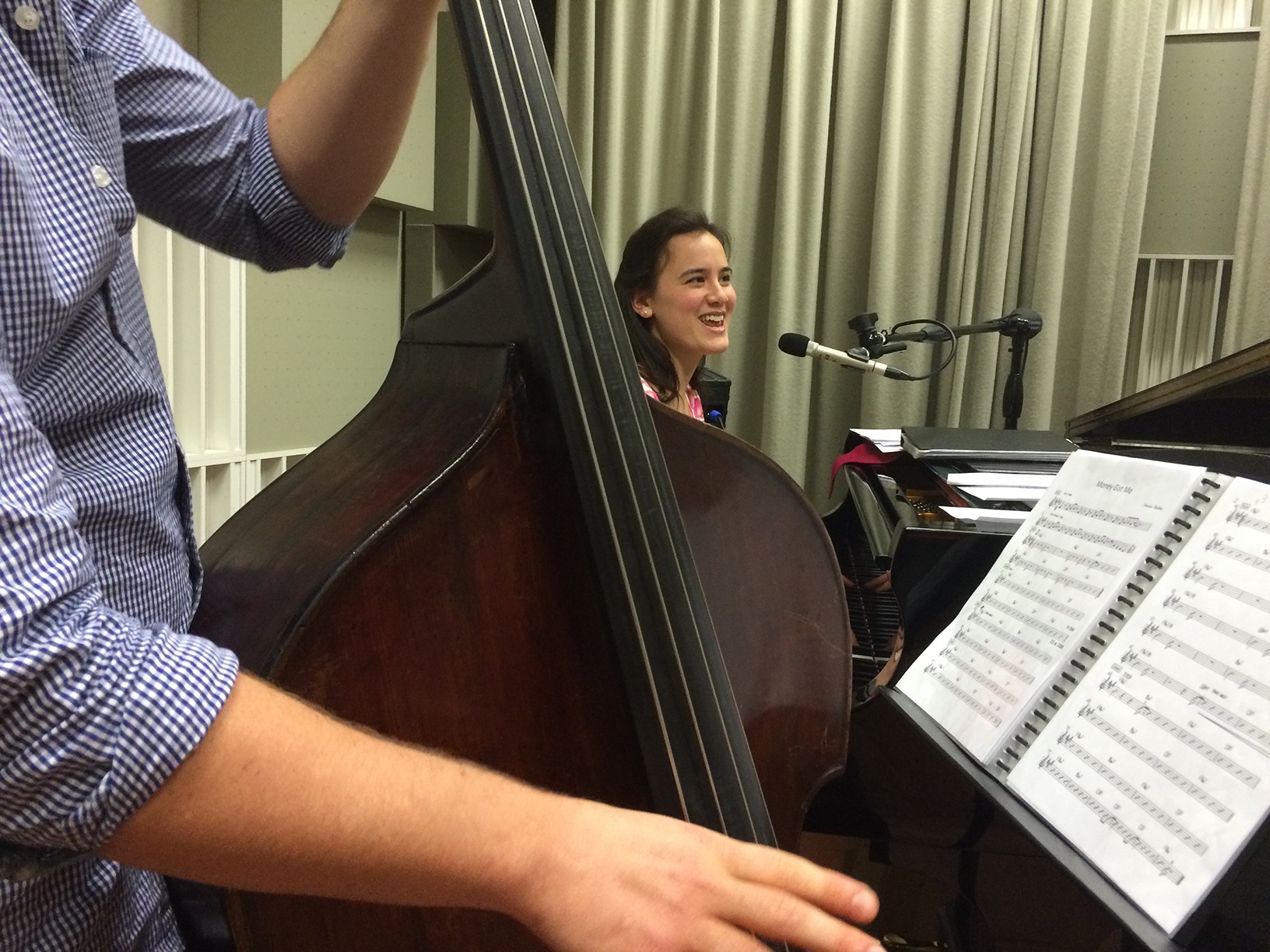
A live performance broadcast from Studio C featuring Frances Madden (jazz)
Presenter- Matt Bailey
Presenter- Sally Cameron
Engineer- Roger Doyle
Questions to keep in mind today
Because I am trying to find out how Fine Music radio station participates in the wider community, the following questions will help me learn more about this organization.
This is called the 5-minute interview
1. What is the name of your program and what genre of music do you specialise in?
2.How long does the program run and what time is it on?
3.How long does it take to assemble your program?
4.What relationship do you have with listeners? (Philosophical/reflective)
5.Have you had any formal training?
6.How did you become involved with Fine Music?
- Q.What’s the name of the ensemble performing tonight?
- A. Francis Madden-Piano
- Bass Guitar- Mike Walder
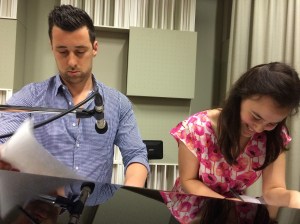
Frances and Mike Oct 2 Interview: Sally Cameron (Presenter)
JT: What is the name of your program and what genre of music do you specialise in?
SC: It’s called Friday night Jazz session, so it’s exactly what it sounds like, it’s the 7pm session on Fridays, one hour of Jazz and I’m a professional Jazz musician. I play say 50% 50% Australian contemporary Jazz and then old school as well.
JT: How long does it take to assemble your program?
SC: It’s different week to week but I’m often, umm sometimes I want to promote certain things that are coming up like for e.g I’ve just done a pre-recorded for the next show, which I want to promote a show that is happening on the Saturday night, so I’m playing Mark Isaacs and bits and I’m playing his tunes.
JT: Is this your own live show that you’re promoting? NB. (Sally finished answering the previous question in the next passage)
SC: No, just Mark Isaacs and sometimes there is no theme at all. I usually play music that I know something about, so it might be my friends or colleagues or music I particularly like to listen to, so I don’t spend a lot of time, you know, I do a little bit of research and make sure who the composers are, which album it came from, who’s playing on the album and when they might, when people might be able to go and see them play. That sort of thing so, probably about an hour I’d say.
JT: This is going really well,
SC: (laughs) yes it is
JT: This is more of a philosophical or reflective sort of question, but what relationship do you have with listeners?
SC: Hmm, it’s an interesting one, because most presenters I’m sure would say the same thing because you don’t know how many people are listening (laughs) it’s really bizarre, I guess I just talk to them like I talk to my friends, exactly how I’m talking to you right now. I try to remain fairly colloquial and casual, give them enough information but not too much and just keep it all light and happy. People have turned the radio on to hear some music, just to relax and enjoy some jazz.
JT: Great answer
SC: A bit of an odd answer?
JT: No not at all, I think that was a really great response because by the time I finish this study and compare these answers with responses from other presenters, I really feel that there will be an interesting ambiguous paradigm structure emerging for the first time in this organisation. So please don’t feel embarrassed, I feel that you’ve hit the target with that profound response.
JT: Have you had any formal training?
SC: No, just training here at Fine Music
JT: Onsite? That’s great!
JT: This is the last one, how did you become involved with Fine Music radio?SC: I was interested in becoming a jazz presenter about four years ago. I spoke to my friend Emma Paske about it and we both thought, why don’t we just ring up and see how we go, this was at another station actually and they let us both start on the midnight show, (LAUGHS) and sort of cut our teeth on that, so I spent a couple of years there and then I was asked to come and join here at Fine music.
JT: Sally, thank you so much for answering those questions
SC: You’re welcome
JT: I really appreciate it.
SC: No problem, are you coming into the recording studio?
JT: Yes, I shall see you there shortly. (Frances Madden Duo performed live to air broadcast Oct 2; 7pm start)
SC: Okay, great, see you soon.
JT: See you there.
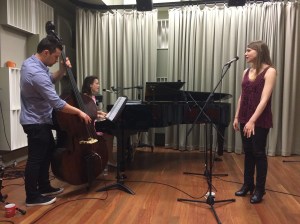
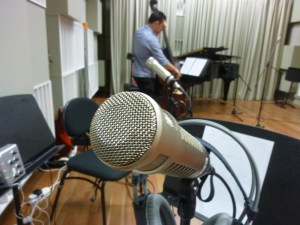
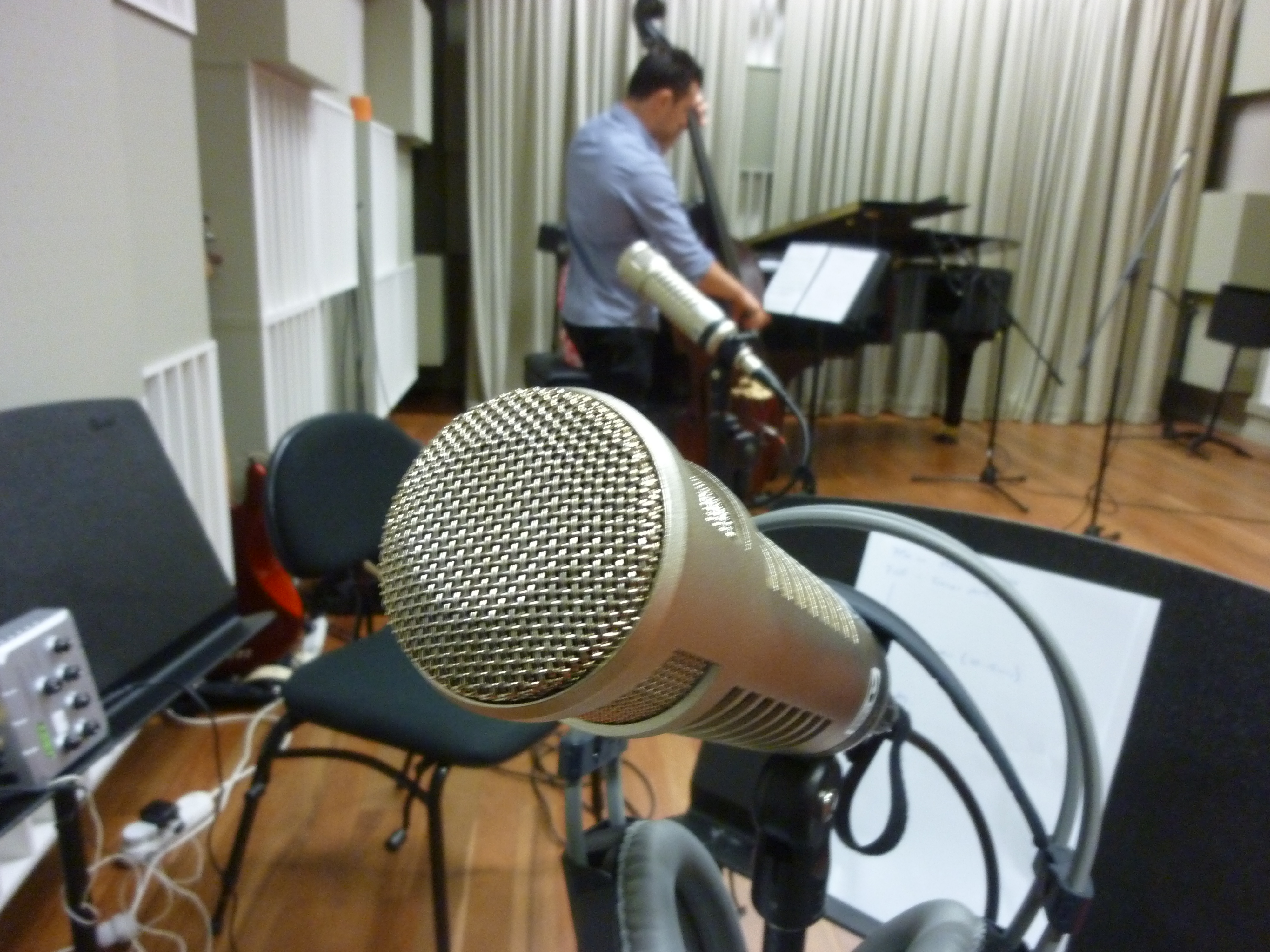
Frances Madden sound check 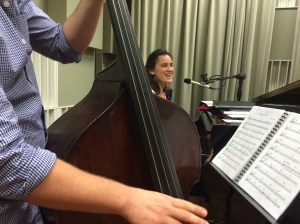
Frances Madden Oct 2 Interview: Matt Bailey (Presenter)
JT: Because I am trying to find out how Fine Music radio station participates in the wider community, the following questions will help me learn more about this organization.
MB: Sure.
JT: What is the name of your program and what genre of music do you specialize in?
MB: It’s jazz Vibes on Fine Music
JT: Yes.
MB: The genre of the show is and I don’t mean to blow my own horn here but it is pretty unique for the station because it’s
JT: Please blow your own horn, that’s fineMB: I’m the only show that does contemporary jazz and a lot of what I play is written and or performed in the last four to six weeks.
JT: Oh wow.
MB: So therefore, if it’s contemporary stuff, it’s on my show. There’s a few other shows on a Monday with Susan Gay Dowling and Peter Nelson doing the Australian scene or something I think it’s called, I can’t remember the name of their show I’m afraid, and it has a lot of Australian content but you know I think they play mostly Australian content that is from a few years ago. The goal of my show is that it doesn’t have to be Australian content I just has to be new. So I play a lot of new stuff, which is completely fine because I am communicating with a lot of artists and they’re sending me a lot of material to play because they want exposure.
JT: Do you think playing that current music is also having an effect on the type of listener that you are aiming towards?
MB: I hope so! It was a pretty divided audience in the beginning and I used to get a few complaints. People would call up or send e-mails saying don’t play that nonsense and that’s fine. So I think it’s changing and I think it’s important.
JT:I didn’t realise that there was a contemporary Jazz program at Fine Music and it is refreshing to see because it allows a younger audience to participate and it educates them about traditional forms of jazz, which I believe is paramount. I have noticed the Peter Mitchell program (noon Jazz), which is great!
MB: Peter Mitchell’s great! His noontime Jazz program is great fun.
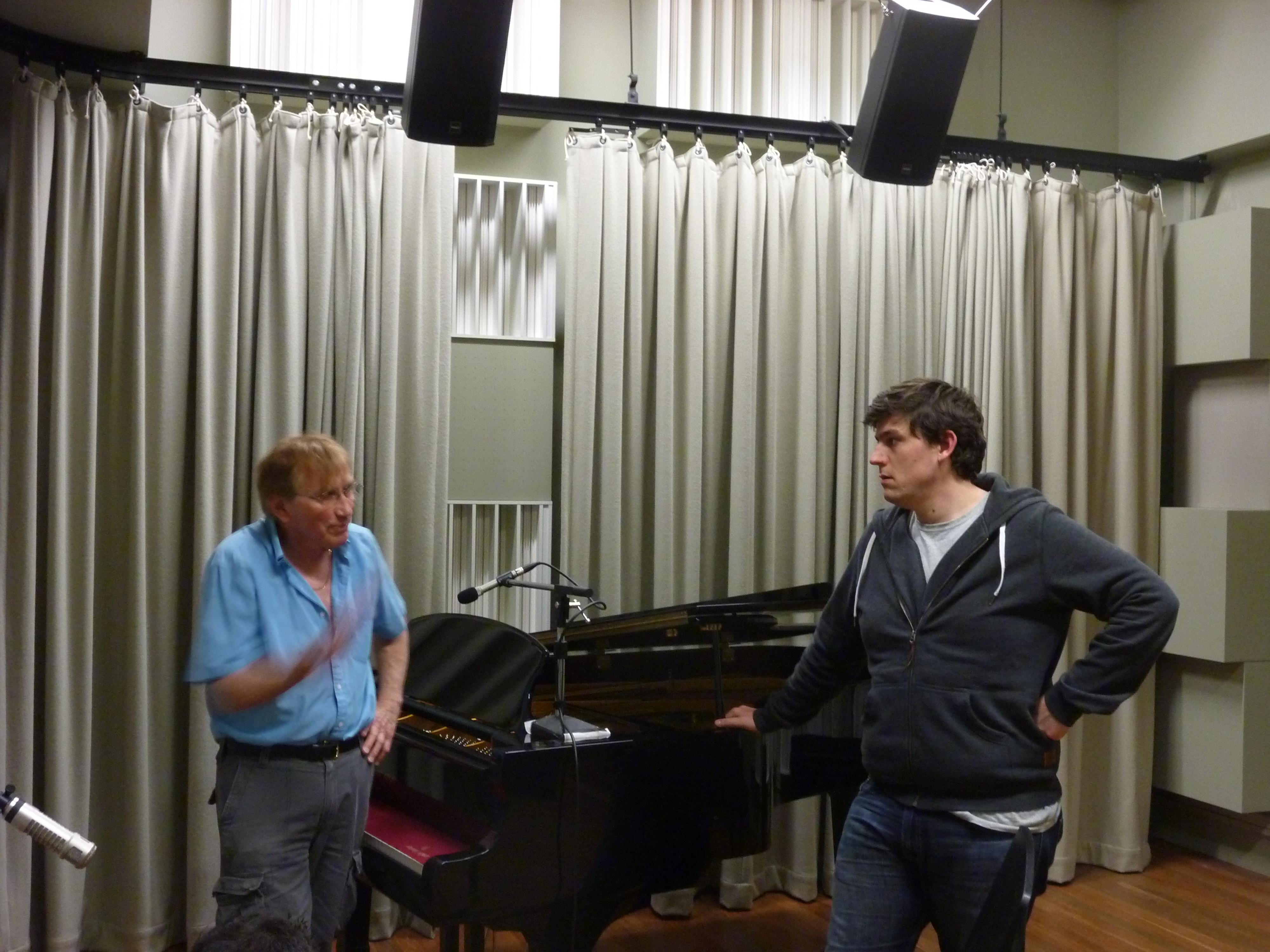
At this point of the interview a colleague who is also in the room Roger Doyle (Engineer) Makes a very interesting comment about Fine music…
the person that has really made a lot of people aware of stuff is the winner of the first Kruger award in 2014 Saxophone player; Nick Russoniello. This made a lot of people aware of how flexible an instrument, brass instruments can be. Nick plays a wide range of music and you see old crocks sitting there and to me (pause) says it all.MB: YEAH! For sure.
JT: I see. (Nods head in agreement)
MB: See I hope it opened up a few more avenues for listener-ship and a more progressive crowd of listeners.
JT: The next I’d like to ask is how long does it take to assemble your program?
MB: It really depends, you know there’s a lot of research that goes into finding new music, and seeking out from artists and seeking out from record labels, independent labels and just finding what they’re putting out. Maybe sometimes, a lot of what I play, I play at least two to three tracks each night that are advanced copies of stuff, stuff that isn’t released yet. So I play a lot of new release stuff that is either coming out in the next month or next day of what I’m playing, so there is a fair amount of prep that goes into that. I’d say that I’m pretty fast at it because I’ve gotten used to it so I’m, it sort of progresses through the week.
JT: Okay
MB: I often won’t have a show ready until 5pm, the same day that the show is about to air.
JT: Right, okay.
MB: It’s just the nature of the show, I don’t program in advance, I know a lot of presenters do and they get their shows ready, they have four weeks worth of shows in the bag before they even come in and that’s fine. I think that’s actually really way more organised than I’ll ever be. For me, I have a very different way of organising things and I like being more spontaneous and I’ve done a few shows now where I have not programmed anything, just brought in a whole bunch of tracks and let’s just see where this goes and sort of play the vibe of the show rather than program things. Because sometimes you just miss something and you’ll play a track which has a musician from another track in it that you played a bit earlier and it’s like well, you could’ve tied them in by playing them next to each other. I often program around key and tempo as well, so I’ll find I’ll play some weeks where a lot of tracks are quite quick in tempo. In terms of prep I’d say a good two or three hours a week at least of just, and If I’m being honest most of it is done between midnight and 4 am for me.
JT: Honest, yes that’s good
MB: Because it’s when I most awake. I’m a night owl.
JT: Well that’s exciting
MB: The USA, a lot of response back and forth from different American labels on new releases and so they’re awake at that time, 4am so its good for me to e-mail them and then a lot of them respond straight away or even Skype or phone. It all depends; sometimes a show might take thirty minutes.
JT: Yes
MB: Sometime it takes three hours; it depends on what I’m doing.
JT: This question is more of a philosophical or reflective type of inquiry. What relationship do you have with listeners?
MB: In what context? Do you mean do I get callers?
JT: Well it could be that, or what has happened in the past, what do you anticipate, what are you looking for? I ask this question to get a sense of audience. Do you have friends, do you get feedback?MB: I see, first of all I get a lot of listeners who are friends because I post about my show every week just about, through my own Facebook feed and through some sponsored Facebook feed which gets a lot of likes and listens and stuff like that and the listen live links which are great. I was managing the Fine Music radio Facebook page for a time. I like to keep the technology new…
JT: Spontaneous?
MB: That’s right! I do communicate with a lot listeners even in a show level sometimes, that why I why I really love having guests on like tonight and I love having to interview subjects because, if you can interview someone it becomes a bit more personable, a bit more there in the moment.
JT: YesMB: I never write a script if that makes sense as well? I’ve never written a script for my show ever. I’ve got notes on my stand here, right now but I’ve never written. A lot of presenters here use scripts, which is really good because you can, they can get it right then. A lot of people are dealing with complex dates like Rachmaninoff wrote this piano concerto on this day after he ate this sandwich.
JT: Laughs (merrily)
MB: I don’t think it’s very relevant for what I’m doing but I can see the importance in it.
JT: Great answer
MB: Thanks
JT: Have you had any formal training?
MB: Yes, well sort of, I did some formal training at 3MBS when I was living in Melbourne. But that was mostly sort of programming; the only other training I’ve had was my induction training when I started here four years ago. After that it was an hour with the late Michael Ingamells, who trained me up on interviewing, on air interviewing and he was a lovely man. So that’s it really, it’ probably four hours in total ever; two hours at 3MBS, an hour when I started here and an hour with Michael and that’s really it.
JT: How did you become involved with Fine Music radio?
MB: (Laughs) Well it’s a family business for me, my dad works here and he is the technical manager and my mum has been part of the furniture here for a long time, she’s been a presenter here, rewinding about fifteen years now, she’s been a presenter here, she’s been a board member, a general thorn in the side of many. I am really my mother’s son in that regards (giggles) because I also cause a bit of hell here and there. With the exception of my sister, the entire family, my entire family either works here or volunteers here at some capacity. I think that’s kind of cool, I love it when a place has a real family connection around the place and I’m going to be honest, that family connection has provided me with some leniencies when I’ve screwed up. (Laughs)
JT: (Laughs)
Thanks a lot Matt, perfect, just perfect.MB: Cool
Frances and Mike 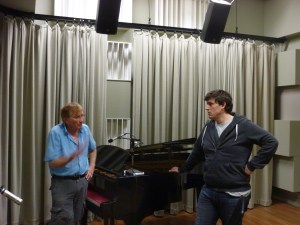
Left to Right:Engineer Roger Doyle and Presenter Matt Bailey 
-
EMPIRICAL & HEURISTIC: A COLLABORATIVE METHODOLOGY RESEARCH
by Joseph Tabua

The investigation that David Nolan and I are undertaking at Fine Music 102.5 is from the perspective of constructed knowing. Through this professional practice response we are aiming to unpack the real and material conditions which enable, or inhibit, the creative life. Through collaboration, I am able to conceptualize two key parameters such as ‘Shared Values’ and ‘Objectives.’ These guideline components will operate as a point of departure in helping shape and define our methodological research. As researchers we are cognizant and do not rely on intuitive, instinctual thinking.[1] Therefore, this collaboration, I consider is an avenue that will sustain a generative dialogue.
Joseph Tabua
September 2014This research will investigate the realm of Sydney’s first radio station to appear on the FM bandwidth, FINE MUSIC 102.5, FINE music radio specializes in the classical music genre. My inquiries will consider various strands that branch from complex engagements and the hypothesis that is ordinarily unrecognized inside the undertaking of a community based radio station.
Working in collaboration with David Nolan, who will be investigating to a greater extent the practical parameters inside Fine music. David’s individual research will be focused upon the technological practicalities in co-operation with my analysis of the inner social interactions at Fine music. Our chief objective is to derive a concise narrative that will support the reflective and factual accounts we shall gather as interns at FINE music. It is then also by immersing oneself inside this discipline; we can interpret both the ethnographic and logistic apparatus in a clear and lucid style. Collaboration will be mobilised by way of our individual WordPress sites https://josephtabua.wordpress.com in addition to this, weekly conferences will take place each week at UWS, Kingswood. Since Week 2 Spring session I have put in motion a reflective process diary, which can be viewed on my individual WordPress site. My impression of working at FINE music and the ambience of the place have already been documented and this reflection will continue with more educational snippets and videos to be uploaded at intervals. The intention of this research is to delve into the arrangement of processes. For E.G how is a program or live performance developed, from off site recordings, to on site broadcasts, all of which are interrelationship-based disciplines. By conducting this research it will also inform me of the audience and the phenomenon to assimilate into the radiobroadcasting milieu. The effectiveness of collaboration encourages us to establish disparate processes in which this permits the analysis of information accumulated, for research methodologies are never ‘objective’ but always located, informed by particular social positions and historical moments and their agendas.[2] The ultimate goal is for scholarly discourse to emerge as the result of this cross-connecting practice. Considering the time frame we have left to explicate this newly acquired data, I am confident that by the conclusion of this research, what should result is a sophisticated, theoretical and logical presentation.References
Bartlett, B., & Bartlett, J. (1998). Practical recording techniques. Boston: Focal Press.
Eyerman, R., & Jamison, A. (1998). Music and social movements: Mobilizing traditions in the twentieth century. Cambridge [England: Cambridge University Press.
Hannan, M., & Music Council of Australia. (2003). The Australian guide to careers in music. Sydney: University of New South Wales.
John-Steiner, V. (2000). Creative collaboration. Oxford: Oxford University Press.
McLeish, R. (1999). Radio production: A manual for broadcasters. Oxford: Focal Press.
Neill, A., & Ridley, A. (2002). Appreciation and the Natural Environment. In Arguing about art: Contemporary philosophical debates (p. 127). London: Routledge.
Saukko, P. (2003). Doing research in cultural studies: An introduction to classical and new methodological approaches. London: SAGE.
[1] John-Steiner, V. (2000). Creative collaboration. Oxford: Oxford University Press.
[2] Saukko, P. (2003). Doing research in cultural studies: An introduction to classical and new methodological approaches. London: SAGE.
-
Tabua Harrison Sydney, Australia 2014
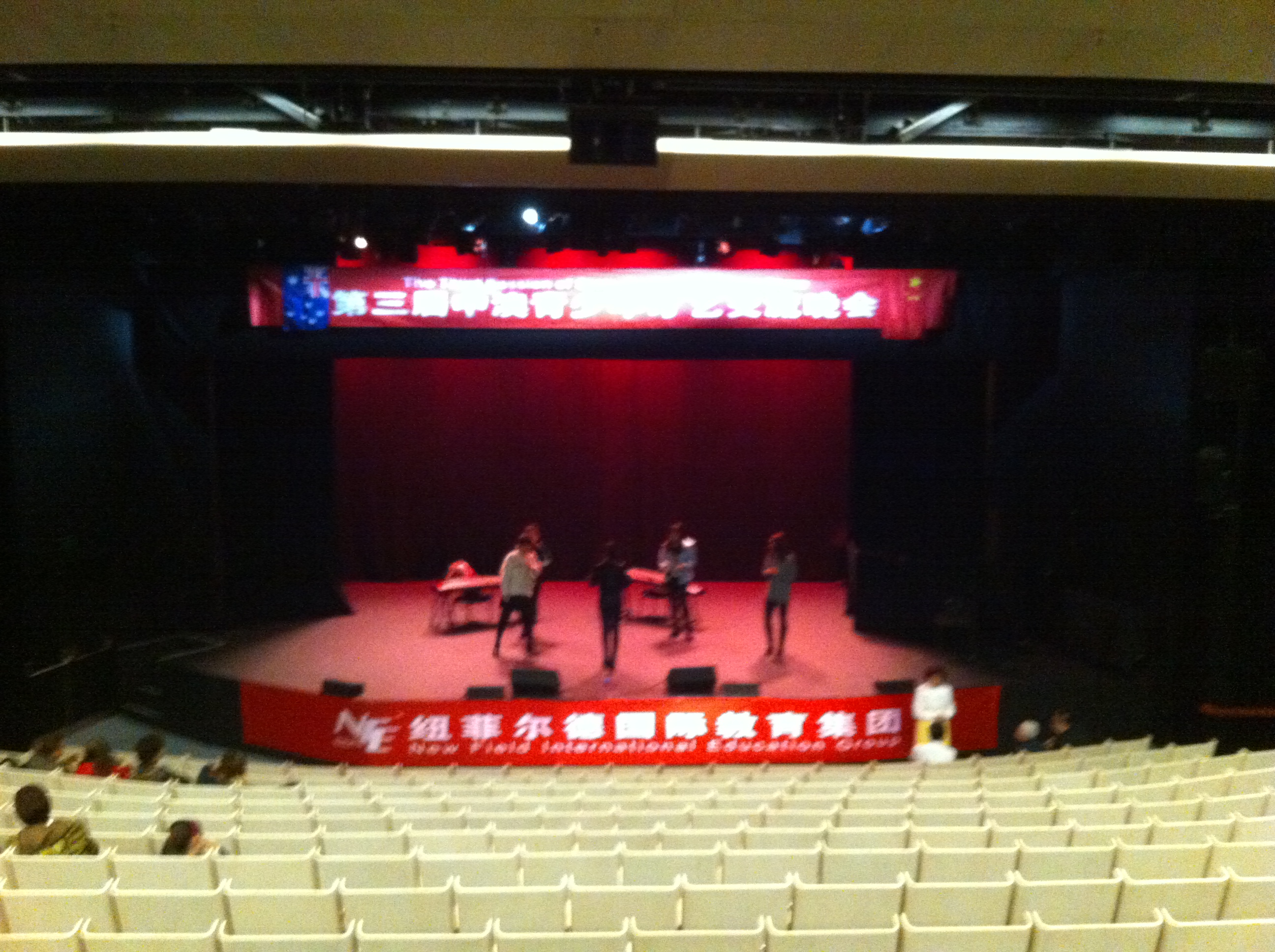
My experimental noise-rock group Tabua Harrison performed on Friday the 29th of August at the Sydney Opera House: Playhouse, as part of the Chinese Australian cross cultural education initiative.
Tabua Harrison is Holly Harrison-Drums & Joseph Tabua-Guitar Performers on the night came from far and wide, from places such as China, New Zealand, Wollongong and the Greater Western Sydney region. Tabua Harrison obviously represented the University of Western Sydney contingent as there were participants from the UNSW, Sydney University and the Conservatory High School who were also involved in this enjoyable occasion.

New Field International Education Group 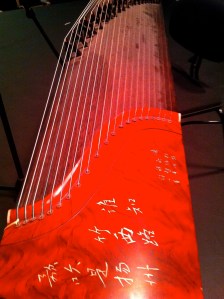
Sharing the stage with many unique cultures. Arriving at the stage door of the opera house for sound check was both exciting and terrifying, one holds a great deal of expectation even when you are the audience, you expect nothing but quality performances and splendor, but to be the attraction on this night was a real pleasure and a privilege.
Tabua Harrison walked onto stage at approximately 8pm, it was a fleeting yet, energizing performance, the audience were very enthusiastic and one sensed that it was a nice change of pace to hear some loud tribal-like rhythmic drums and timbrel explosions via a pulsating electric guitar. The easiest part of this day was the performance, why was this so? One shall never know, perhaps it is better left unanswered. One can comprehend that for an undertaking such as this can take several months or even years to organize, however, it is with these exchanges, a tangible cross cultural pathway is generated. A paramount interchange is amplified significantly when we share our artistic endeavors as we did tonight on the playhouse stage. By sharing our music, our literature, and our stories with one another, we can be certain that traditions like this in the Western/European paradigm will continue for many years to come.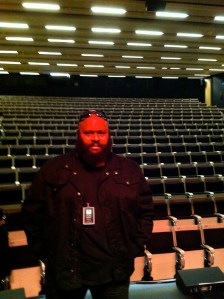
Playhouse Stage Overall, the experience and professionalism that I observed, from stage management, security, chefs, and the staff were extraordinary. There appeared to be a higher level of consciousness at work here, in this awe-inspiring building, however, I appreciate that an organization such as the Sydney Opera House is an Australian icon,a symbol of excellence.
-

Signing relevant paperwork for my internship (scholarly research) at Fine Music FM. - Fine Music 102.5 FM
The Facts
Owner and operator of Australia’s first community operated stereo FM station.
Librarians start work at 7:30am and finish on average at about 12pm
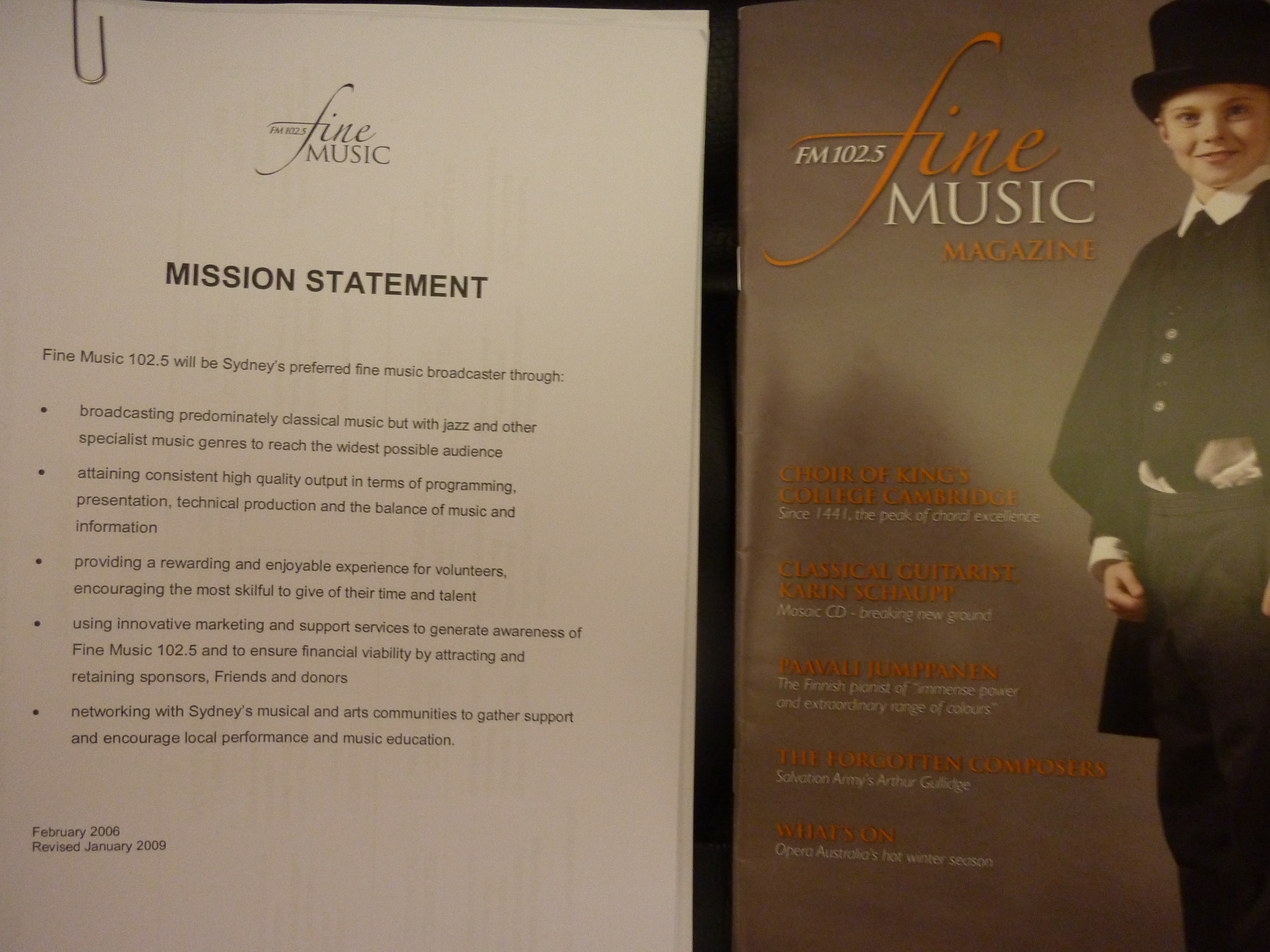
Fine Music Magazine is a monthly subscription, which can also be read on-line.
The magazine is delivered by a volunteer directly to the subscribers doorstep.
My research today is essentially a case study type of awareness: - Arrived at 9:25 am
- Chatting with Steve Marc about expectations relating to my research.
- Working with Helen Milthorpe 10:00am in the library.
- Helen unpacks a wealth of information about FINE Music FM and much illuminating discussions takes place about the role of the librarian in this particular domain.
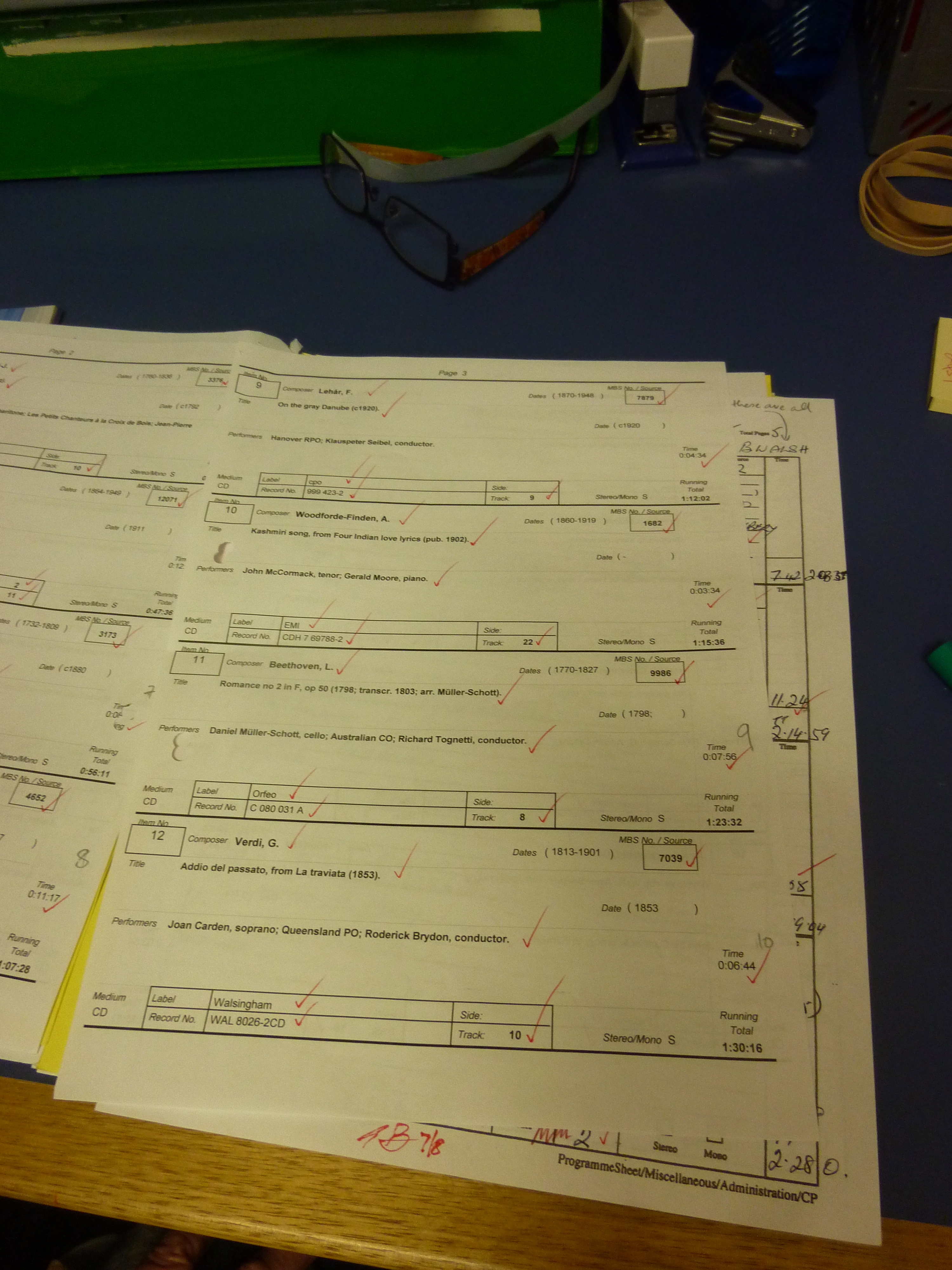
- Programmers submit a program-attaching a program cover sheet that details playlist duration.
- 6-9am morning and current playlist.
- Drive Program starts at 4pm.
- Jazz starts at 12 Midday.
- Saturday morning music6-9am.
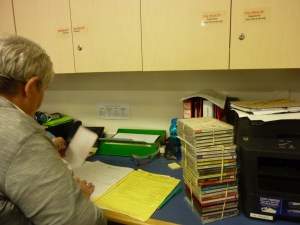
Fine Music Librarian Helen Milthorpe uncovers the precise details. How do people implement this program? What challenges do people face?
- What are people’s perceptions?
- The librarians duty is to collect what the presenter has written down on a word document and the librarian is there to see if any errors arise. For E.G song duration
- Drive and breakfast are not typical in the way the person that chooses the work prepares and puts it to air
- One and a half minutes per half hour are allocated to implement advertisements
- Presenters provide complete song list/playlist duration and back up disc
The librarian checks these - Another task the librarian must perform is the simple task of checking that the CD is inside its case.
- Observing the librarians role inside the 102.5 FM this morning has been a very insightful and prescient undertaking that must take place for a program to materialize.
- Another factor that needs to be considered is the checking and re-checking of programs soon to be aired and the enormous amounts of paper work that must be signed off before the presenter enters the radio booth.
- All cover sheet playlists are kept because once every month the playlist cover sheets are viewed by APRA/AMCOS in order for royalties to be allocated to composers and or performers.
- Helen’s work is of acute awareness concerning programming and perceptions that help FINE music remain in the community’s consciousness. Helen’s work at Fine Music FM is of a volunteer capacity.
Another highlight to the morning was to see the radio stations commitment to assisting persons with disabilities in the community. I was introduced to a young adult Alex who was assisting in the library department; he was resetting CD’s in the archive.
Leaving no stone unturned. 
Play lists are compiled by both radio presenters and volunteer librarians 2-3 days before they’re broadcast to air. - Talking with a volunteer librarian Gaby Brown this morning, who has worked for Fine Music FM for 20 years, emphatically described the place as a wonderful institution.
- A communication book titled ‘The Black Book is utilised by all the volunteer librarians
- Each month there is a CD library check/this task is performed with the endeavour of maintaining music content ( CDs, LPs, Tapes)
- Another folder is dedicated to CDs with errors.
- Helen indicated that a lot of the volunteer librarians at Fine Music FM are aged between 70 -80 years of age.
- Generally there appears to be a lot of older men and woman volunteers who frequent the hallways of Fine Music FM, and this could be the result of the demographic that Classical music engages in.
- The target audience is another branch I will investigate as this research develops over the coming months.
- At 12:40pm I was summoned to Radio Booth No.1 to join Peter Kurti who was presenting a jazz program. I sincerely wished I had filmed this encounter but no cellular phones were permitted into the studio at this time. As I entered Peter was playing a very familiar piece titled ‘Blue Nile’ by Alice Coltrane and Pharoah Sanders, and as I looked up at Peter I indicated my great satisfaction with a thumbs up gesticulation, in which Peter reciprocated with an enthusiastic smile of approval. It’s quite extraordinary how music can bring minds together profoundly, even if they’re strangers, music is the meeting point, a bridge, the community.
- Fine Music 102.5 FM
-
- August 8th First visit to Fine Music 102.FM
- Spoke at length with Station Manager Liz Terracini and Program Director Steve Marc about my research project and effectively what my study is about. Further discussion about expectations and what I hope to achieve through a professional practice research, to be undertaken at Fine Music 102.5 FM
- I have been summoned to work on a live broadcast for Fine Music FM on August 30th
- Details of the ensemble to be recorded are yet to be confirmed
Dual radio channel (conventional radio and digital radio) - Monday –Friday between the hours 12pm-4pm the line is split: meaning there are two simultaneous broadcasting streams in motion (alternate programming)
- Playlist uses a program called Netia to assemble playlist and window of opportunity intro
- There are 290 volunteers that work at Fine Music FM 102.5
- I will undertake the research led project every Friday from the 15th August
- My first investigation commences on Friday 15th August at 9:30am
NETIA- radio automation software
This software tool is used to assist radio programmers when compiling a specific playlist or program.
Netia (Radio Automation Software) from whispering black on Vimeo.
Fine Music FM Program Director Steve-Marc Mculloch explains how Netia works in the studio.
-
Heading into Fine Music 102.5 FM this fine morn.
Stay posted comrades.







-
Subscribe
Subscribed
Already have a WordPress.com account? Log in now.
 Joseph Tabua